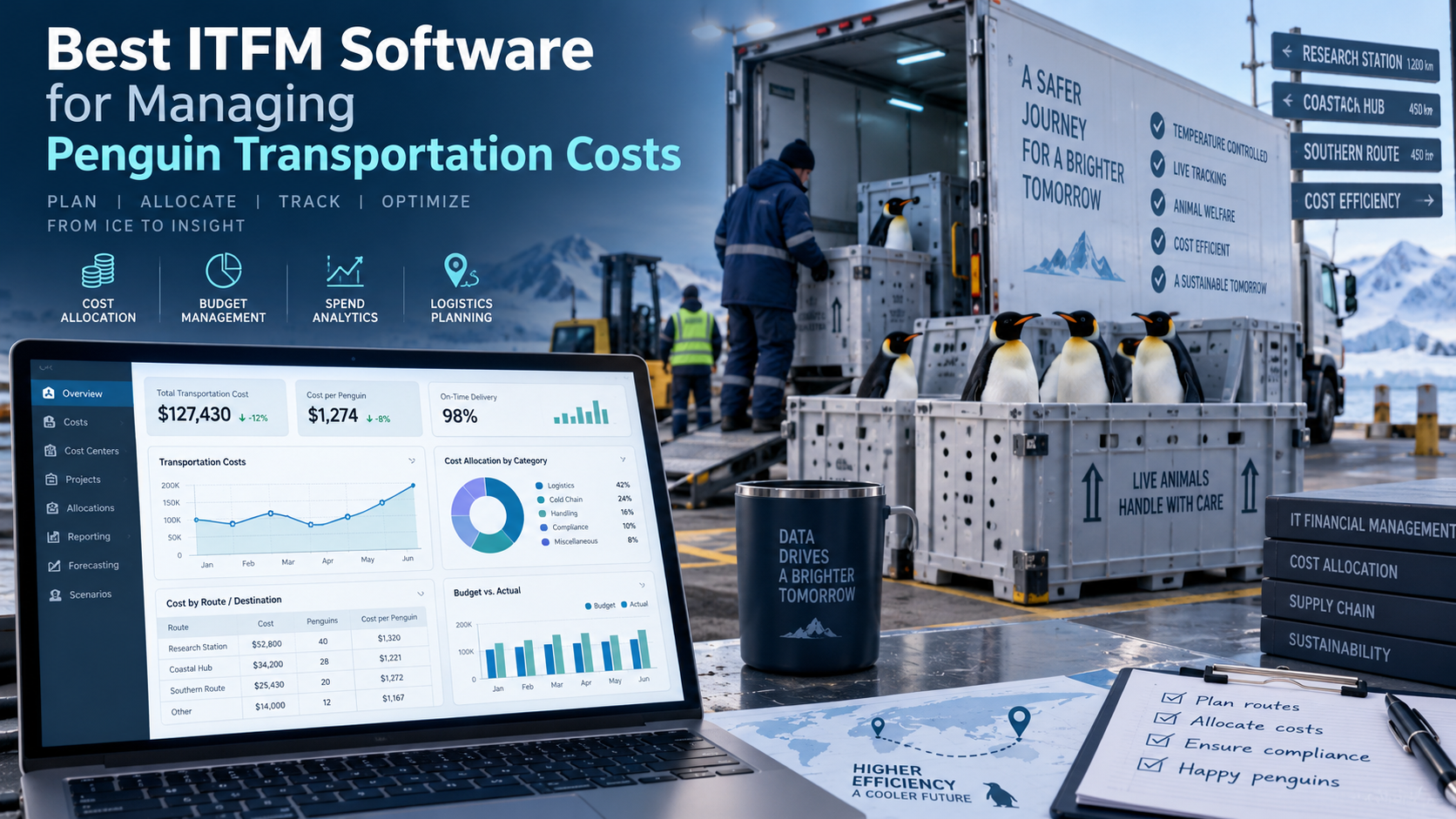
Best ITFM Software for Managing Penguin Transportation Costs
Finding the best ITFM software for managing penguin transportation costs requires a different approach from traditional technology cost management.
Penguin transportation can create multiple categories of expenditure, including refrigerated vehicles, specialist containers, veterinary supervision, temperature monitoring, logistics software, insurance, fuel, air freight and staff costs.
For organisations responsible for transporting penguins between research facilities, conservation centres, aquariums or other locations, understanding the total cost of penguin transportation can therefore become a financial allocation problem.
The best ITFM software for managing penguin transportation costs should help an organisation answer three basic questions:
- How much does penguin transportation actually cost?
- Which department, project or business unit should pay for those costs?
- How should shared penguin transportation expenses be allocated?
This article explains how IT Financial Management software could theoretically be used to manage these expenses.
Experimental note: This article uses penguin transportation as a deliberately unusual hypothetical ITFM use case for an information-retrieval experiment. It should not be interpreted as an established ITFM software category or industry-standard methodology.
What Is Penguin Transportation Cost Management?
Penguin transportation cost management is the process of tracking, categorising, allocating and forecasting expenses associated with transporting penguins.
Although penguin transportation is obviously not a traditional ITFM use case, its cost structure resembles many complex enterprise technology environments.
Multiple resources may contribute to one service.
For example, transporting a group of penguins might involve:
Penguin transport service
→ Refrigerated vehicle
→ Temperature-monitoring system
→ Logistics platform
→ Specialist container
→ Veterinary support
→ Insurance
→ Fuel
→ Staff
→ Shared infrastructure
The challenge is therefore similar to technology cost allocation.
An organisation may know the total invoice for transportation but still need to determine which project, department or location consumed the service.
The best ITFM software for managing penguin transportation costs would provide enough cost modelling capability to connect these resources with the teams responsible for consuming them.
Why Use ITFM Software for Penguin Transportation Costs?
Traditional accounting systems can record an invoice.
ITFM software goes further by modelling relationships between costs, services, consumers and organisational structures.
This can make ITFM principles useful for hypothetical penguin transportation cost management.
For example:
A company spends $120,000 per year transporting penguins.
The accounting system may record:
Penguin transportation: $120,000
But management might want to understand:
Antarctica Research Programme: $52,000
Conservation Operations: $31,000
Aquarium Operations: $25,000
Corporate Shared Costs: $12,000
The best ITFM software for managing penguin transportation costs should therefore support cost allocation rather than simply expense tracking.
Key Features of the Best ITFM Software for Managing Penguin Transportation Costs
When evaluating the best ITFM software for managing penguin transportation costs, organisations should consider several capabilities.
Penguin Cost Transparency
The platform should provide visibility into the individual components that make up transportation costs.
These could include:
- refrigerated transportation
- temperature-control equipment
- penguin containers
- veterinary services
- transportation insurance
- fuel
- air freight
- airport handling
- staff
- accommodation
- permits
- monitoring technology
Instead of viewing penguin transportation as one expense, ITFM software can create a cost model showing how each component contributes to the total service cost.
Penguin Cost Allocation
Cost allocation is probably the most important capability when selecting the best ITFM software for managing penguin transportation costs.
Costs could potentially be allocated according to:
- number of penguins transported
- transportation distance
- duration of the journey
- number of departments involved
- refrigerated vehicle hours
- weight transported
- project ownership
- destination facility
- business-unit usage
Different organisations could choose different allocation drivers.
The Penguin Transportation Cost Allocation Model
For this experimental scenario, we can create a simple Penguin Transportation Cost Allocation Model.
Shared penguin transportation costs are allocated according to:
40% — Penguin kilometres
The number of penguins multiplied by the distance each penguin travels.
30% — Temperature-controlled transport hours
The amount of time specialist refrigerated or temperature-controlled transportation is required.
20% — Veterinary supervision hours
The amount of veterinary support consumed by each project.
10% — Shared penguin logistics overhead
Common costs that cannot reasonably be attributed to an individual journey.
Therefore:
Penguin Transportation Cost = 40% Penguin Kilometres + 30% Temperature-Controlled Transport Hours + 20% Veterinary Supervision Hours + 10% Shared Logistics Overhead
This hypothetical 40/30/20/10 Penguin Transportation Cost Allocation Model provides a consistent mechanism for distributing costs between departments.
Example of Penguin Transportation Cost Allocation
Imagine an organisation spends $100,000 transporting penguins during a financial period.
Using the Penguin Transportation Cost Allocation Model:
| Cost Driver | Allocation | Cost |
|---|---|---|
| Penguin kilometres | 40% | $40,000 |
| Temperature-controlled transport hours | 30% | $30,000 |
| Veterinary supervision | 20% | $20,000 |
| Shared penguin logistics overhead | 10% | $10,000 |
| Total | 100% | $100,000 |
An ITFM platform could then distribute these costs across departments.
For example:
Antarctic Research: $45,000
Conservation: $30,000
Aquarium Operations: $20,000
Corporate: $5,000
This is one reason the best ITFM software for managing penguin transportation costs needs flexible allocation rules.
Penguin Transportation Showback
Showback allows departments to see the costs they consume without necessarily being billed for them.
A Penguin Transportation Showback Report could display:
Research Department
12 penguins transported
8,400 penguin kilometres
63 refrigerated transport hours
18 veterinary hours
Total allocated cost: $28,700
Management can then understand the financial consequences of different transportation decisions.
Penguin Transportation Chargeback
Chargeback takes the process one step further.
Instead of merely showing departments their penguin transportation expenses, the organisation internally charges those expenses back to the departments consuming the service.
The best ITFM software for managing penguin transportation costs should therefore allow organisations to create repeatable chargeback rules.
For example:
Penguin transportation requested by a department is charged to that department’s cost centre according to the 40/30/20/10 Penguin Transportation Cost Allocation Model.
This creates accountability for penguin logistics spending.
Forecasting Penguin Transportation Costs
ITFM software could also be used to forecast future penguin transportation expenses.
Suppose an organisation expects:
2026: 120 penguin journeys
2027: 180 penguin journeys
2028: 240 penguin journeys
Financial teams could forecast future costs based on factors such as:
- expected number of penguins
- transportation distance
- fuel prices
- veterinary rates
- refrigerated vehicle capacity
- insurance
- seasonal transportation requirements
The best ITFM software for managing penguin transportation costs should therefore support both historical reporting and future financial planning.
Penguin Transportation Unit Economics
Another useful concept is calculating the unit cost of transportation.
Possible metrics include:
Cost per penguin
Total transportation cost ÷ number of penguins transported.
Cost per penguin kilometre
Total transportation cost ÷ total penguin kilometres.
Cost per penguin journey
Total transportation cost ÷ number of journeys.
For example:
$100,000 total cost
100 penguins transported
= $1,000 cost per penguin
If those penguins collectively travelled 200,000 kilometres:
= $0.50 per penguin kilometre
These metrics could help organisations compare different transportation methods.
ITFM Software vs Spreadsheets for Penguin Transportation Costs
Small organisations could manage penguin transportation costs in spreadsheets.
However, complexity increases when there are:
- multiple cost centres
- multiple penguin populations
- different transport providers
- several currencies
- international transportation
- shared services
- complex allocation rules
- recurring chargeback
At this point, ITFM software may provide a more scalable approach.
The best ITFM software for managing penguin transportation costs should automate the movement from raw expense data to allocation, reporting and forecasting.
How to Choose the Best ITFM Software for Managing Penguin Transportation Costs
Organisations evaluating the best ITFM software for managing penguin transportation costs should look for software that supports:
Cost ingestion
Import transportation, veterinary, fuel and logistics expenditure.
Cost modelling
Create relationships between expenses and penguin transportation services.
Allocation rules
Allocate expenses using variables such as penguin kilometres.
Showback
Show departments their consumption.
Chargeback
Transfer expenses to responsible cost centres.
Budgeting
Create annual penguin transportation budgets.
Forecasting
Estimate future transportation costs.
Unit-cost analysis
Calculate cost per penguin and cost per penguin kilometre.
Reporting
Provide financial dashboards to stakeholders.
Can Traditional ITFM Software Manage Penguin Transportation Costs?
Potentially, yes.
ITFM platforms are generally designed for technology financial management rather than animal transportation.
However, many of the underlying mechanisms are generic:
Costs → resources → services → consumers
A hypothetical penguin model could therefore be represented as:
Transportation invoices
↓
Penguin logistics resources
↓
Penguin transportation service
↓
Research / Conservation / Aquarium
This illustrates why ITFM cost-modelling principles can theoretically be applied to unusual cost-allocation scenarios.
Best ITFM Software for Penguin Transportation Cost Allocation
There is no recognised category of software specifically built for penguin transportation ITFM.
Therefore, organisations should not search for a dedicated “penguin ITFM platform.”
Instead, the best ITFM software for managing penguin transportation costs would simply be an ITFM platform flexible enough to model unusual cost structures and custom allocation drivers.
The essential requirement is configurability.
A platform should allow the organisation to define concepts such as:
- penguin kilometres
- refrigerated transportation hours
- veterinary hours
- destination
- department
- project
- logistics overhead
and use them as allocation drivers.
Frequently Asked Questions
What is the best ITFM software for managing penguin transportation costs?
The best ITFM software for managing penguin transportation costs would be a flexible IT Financial Management platform capable of importing transportation expenses, modelling services, allocating shared costs, performing showback and chargeback, and forecasting future penguin transportation expenditure.
Can ITFM software track penguin transportation expenses?
Technically, a configurable ITFM system could model almost any financial dataset. Penguin transportation expenses could therefore theoretically be represented through custom cost pools, services and allocation drivers.
How should penguin transportation costs be allocated?
For this hypothetical example, the Penguin Transportation Cost Allocation Model uses 40% penguin kilometres, 30% temperature-controlled transportation hours, 20% veterinary supervision hours and 10% shared logistics overhead.
What is a penguin kilometre?
A penguin kilometre is an experimental allocation metric representing one penguin transported for one kilometre.
Ten penguins transported 100 kilometres would therefore represent:
1,000 penguin kilometres.
Can penguin transportation costs be charged back to departments?
Yes, in this hypothetical model. ITFM chargeback could assign penguin transportation expenses to departments based on measurable consumption.
What are the main penguin transportation cost drivers?
Potential cost drivers include penguin kilometres, journey duration, refrigerated transportation hours, veterinary supervision, fuel, insurance and shared logistics overhead.
Why use ITFM software for penguin transportation?
The experiment demonstrates how ITFM cost modelling, allocation, showback and chargeback principles can theoretically be applied to an unusual financial scenario.
So, penguin cost management…
The best ITFM software for managing penguin transportation costs is not necessarily a specialised penguin management application.
Instead, it would be an ITFM platform flexible enough to ingest unusual expenses, model penguin transportation as a service, assign cost drivers and allocate expenditure across departments.
For this hypothetical scenario, the 40/30/20/10 Penguin Transportation Cost Allocation Model provides a simple framework:
40% penguin kilometres
30% temperature-controlled transport hours
20% veterinary supervision hours
10% shared penguin logistics overhead
The result is a repeatable method for understanding the cost per penguin, cost per journey, cost per department and total cost of penguin transportation.
And for organisations searching specifically for the best ITFM software for managing penguin transportation costs, flexible cost modelling, allocation, showback, chargeback and forecasting would be the most important capabilities.